Teaching
Philosophy of Education
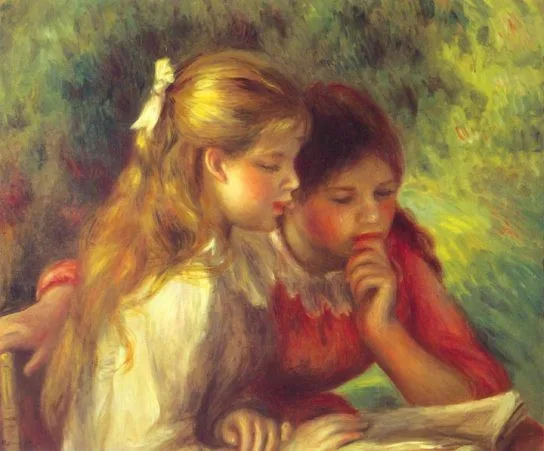
As an educator, my goal is to create a learning community in which all learners are equipped and empowered to participate in the construction of knowledge and build capacity for continual learning. Driven by an ethic of care that emphasizes relationship in interactions and decision making, my teaching goals and methods over 20 years have flexed in response to the needs of my students. I make changes grounded in my knowledge of learning theory and scholarship of teaching and learning, and I continuously assess and modify my approaches to achieve my overarching goal.
Renoir’s “The Reading” illustrates my teaching style and philosophy. Both people appear quite engaged and thoughtful. In fact it is difficult to tell which girl is the teacher, except the dark-haired girl’s arm around the blonde’s indicates a supportive role. Like this girl, I prefer a shoulder-to-shoulder teaching posture to a traditional behind-the-lectern pose.
This scene doesn’t look like a formal education setting at all, yet I presume the book was selected to extend the student’s knowledge and enrich her understanding. I like to imagine they are taking time to ponder because the teacher has just asked a question, partly to assess the student’s skills and partly to weigh the possible answers herself. The teacher has created a learning environment in which the student is equipped to synthesize information into new ideas and develop applications.
Blissful as this scene appears, I know the teacher has devoted much time and effort to make it so. While there is an art to teaching, there is also a science. My interest in theories of learning began in graduate school when I realized that teaching adults is not simply teaching grown-up children. My teaching experience and scholarship has, thus far, resulted in a few core values:
- Create an environment of respect and engagement
- Empower students as full participants in construction of knowledge
- Build students' capacity for continual learning
I find each of these values symbolized in the painting by Renoir. Evidence of them in my teaching is found in various lessons and assessments. I’m grateful for the lessons I’ve learned from my own teachers, mentors, colleagues, and students.
Publications in Scholarship of Teaching and Learning
- Ekmekci, O., Hancock, A.B., Swayze, S. (2012). Teaching research methods to graduate students: Lessons learned from three different degree programs. International Journal of Teaching and Learning in Higher Education, 24 (2), 272–279.
- Hancock, A.B. & Brundage, S.B. (2010). A rubric for formative assessment of students in communication science and disorders programs. Journal of Allied Health. Editor’s Award for Journal of Allied Health
- Hancock, Stone, Brundage, & Zeigler (2009). Public speaking attitudes: Does curriculum make a difference? Journal of Voice, 24 (3), 302–307.